Curling Irons & Wands
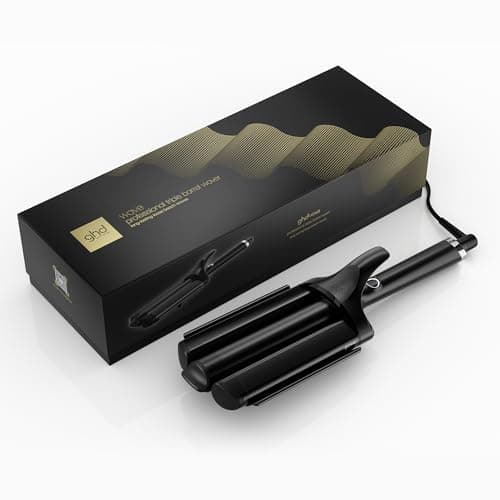
ghd Wave: What the Published Specs Say
A waver is not a curling iron with extra barrels. It is a different object producing a different shape, and it is the fastest tool here.
Updated September 2026 · Sawyer V.
ghd publishes three ergonomic barrels, dual temperature sensors, one fixed temperature of 365°F and a two-year warranty. It publishes no wattage, weight, cord length or voltage rating. It produces an even repeating S-wave in one press rather than a wrapped curl.
We earn a commission if you buy through the links on this page, at no extra cost to you. It never changes which tool we pick or which one we tell you to skip. How this site is funded.
A different object entirely
Every other tool in this hub wraps hair around a cylinder. This one does not. You clamp a section between three barrels and press, and the hair takes the shape of the gap between them — a repeating S-bend, produced in one action.
The consequences run in both directions. It is by some distance the fastest way to put a wave through a whole head, because each press covers a length of hair rather than a wrap. It is also the least controllable, because the shape is set by the barrel geometry rather than by your technique.
So the question is not whether this is a good curling iron. It is whether the specific shape it makes is the one you want.
Uniform is the feature and the limitation
A waver produces a regular, even, repeating pattern. That is exactly the appeal for a deliberate, styled wave — the sort that reads as done rather than as slept-in.
It is also why we name it as the skip on the curly-hair page. Natural curl is irregular. Pressing a regular S-bend through part of a head that already has its own varied pattern gives you two competing patterns, and that reads as damage rather than as styling.
The same logic decides it against beach waves. A beach wave is defined by irregularity — different sizes, alternating directions, ends left out. That is achievable with a single barrel used inconsistently on purpose, and it is not achievable with a tool whose entire design guarantees consistency. The technique is on the beach waves page and the flat-iron route to the same look is on its own page.
What a triple barrel does against a single barrel
| ghd Wave (triple barrel) | Single barrel | |
|---|---|---|
| Shape | Even repeating S-bend | Spiral curl, or a bend |
| Speed | Fastest here — one press per length | Slower — wrap and hold per section |
| Control | Set by barrel geometry | Set by your wrist and hold time |
| Best for | A deliberate, uniform wave | Beach waves, curls, mixed shapes |
| Worst for | Hair with an existing pattern | Nothing in particular |
Fixed 365°F, with sensors
No temperature control. That is the ghd position across their whole range — the Platinum+, the Chronos, the Chronos Curve Classic, the Curve Thin and this all run at one fixed 365°F.
The argument for it is genuine: damage is driven by temperature and by repeat applications, and the temperature most people select given a dial is higher than the one their hair needs. We make the case in full on the Platinum+ review.
What ghd adds here is dual temperature sensors, which is a claim about consistency rather than about the number itself — holding 365°F evenly across three separate barrels is a harder problem than holding it across one, so it is a sensible thing to engineer and to publish.
Where it leaves you short is the same place every fixed tool does. On bleached or double-processed hair, 365°F with nothing below is the wrong shape, and the adjustable T3 tools are the answer — the reasoning is here.
Speed is a damage argument, not just convenience
This is the strongest thing we can say for the Wave and it is worth stating properly.
Total heat exposure is roughly temperature multiplied by contact time, and on a whole head the dominant variable is how many separate applications you make. A tool that puts a wave through a section in one press rather than three wraps is materially fewer applications for the same result.
Whether that nets out in your favor depends on hold time per press, which ghd does not publish. But the direction is real, and it is the same reasoning that favors wide plates and long barrels elsewhere on this site.
Four blank rows
What it costs to run for a year
ghd does not publish a wattage for this tool, so there is nothing honest to compute. The formula is watts ÷ 1,000 × hours a year × your rate per kWh; if you find a rating plate on the handle, 65 hours a year and 18.34 cents per kilowatt-hour will get you the rest of the way.
No wattage, so no running cost. No weight — and on a tool with three barrels rather than one, weight is precisely the specification you would want, because three heated cylinders is more mass than one. No cord length. No voltage rating.
That last one is the consequential gap. ghd publishes universal voltage for the Platinum+ and for the Curve Thin, and states plainly that the Helios is not universal voltage — so they clearly understand the row matters. Leaving it blank here means you cannot take it abroad on anything better than a guess, and the cost of guessing wrong is a destroyed tool. The numbers are on the UK page.
This is the consistent ghd pattern: temperature philosophy and warranty terms in detail, physical specifications sparingly. Same shape as the Chronos.
Price per use, at 5 uses a week over 5 years
| What you pay | Cost per use | Cost per year |
|---|---|---|
| $30 | $0.02 | $6.00 |
| $60 | $0.05 | $12.00 |
| $100 | $0.08 | $20.00 |
| $150 | $0.12 | $30.00 |
| $200 | $0.15 | $40.00 |
| $300 | $0.23 | $60.00 |
| $400 | $0.31 | $80.00 |
| $500 | $0.38 | $100.00 |
5 uses a week for 5 years is 1300 uses. Both figures are stated assumptions, not measurements — halve the life and every cost per use doubles. We publish the ladder rather than a worked example for one specific product because a price we typed into a sentence would be wrong within a week.
Technique, briefly
- Completely dry hair only. Contact heat on wet hair produces steam inside the fiber, and the published microscopy on what that does is unpleasant — the page is here.
- Work in flat, even sections. A twisted section presses unevenly and you get half a wave.
- Overlap each press slightly. Leaving a gap between presses shows as a straight patch in the middle of a wave — the most common mistake with these tools.
- Start below the crown. Waves that begin at the scalp read as frizz and collapse under their own weight.
- Let it cool before touching. Hair sets as it cools.
Who this is for
- Straight hair wanting a deliberate, even wave. The tool does exactly one thing and does it faster than anything else here.
- Long hair where a single barrel means forty sections. One press per length is a real time saving.
- Anyone who does not want to learn a wrist technique. There is nothing to learn beyond overlapping the presses.
Who should skip it
- Hair with an existing curl or wave pattern. Two competing patterns is the outcome.
- Anyone wanting beach waves. Irregularity is the look, and this tool cannot produce it.
- Bleached or processed hair. Fixed 365°F with nothing below.
- Travelers. No published voltage rating.
What we cannot tell you
We have not used this tool. ghd publishes no wattage, weight, cord length or voltage for it, and no hold time per press — which on a waver is the figure that would let you compare its total heat exposure against a single barrel. Every figure above is from ghd’s own product page.
The tools on this page
Prices come from the live price layer. Where none is available the button says so rather than showing a number we cannot stand behind.
ghd Wave triple barrel hair waver
Three barrels in one pass, at the same fixed 365°F ghd puts on everything — a different shape entirely from a single-barrel wave.
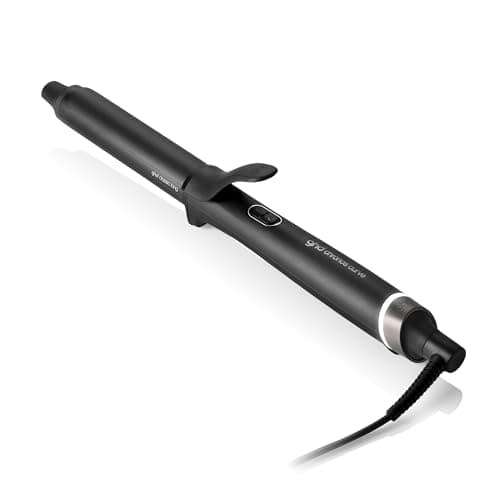
ghd Chronos Curve Classic curling iron (1 inch barrel)
A curling iron with no temperature dial at all — 365°F fixed, and a 20-minute sleep mode, which is unusual restraint in this category.
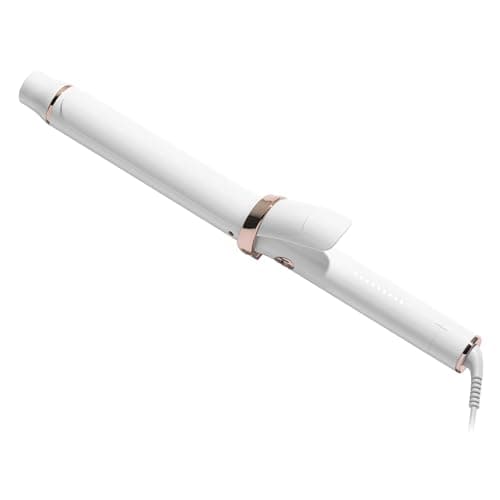
T3 SinglePass Curl X extra-long barrel curling iron
A 6.5-inch barrel and a separate published weight for every barrel size — unusual disclosure in a category where most makers publish a diameter and stop.
Questions people actually ask
What does a hair waver do that a curling iron does not?
It presses an even, repeating S-bend into a length of hair in one action, rather than wrapping a spiral. It is faster and more uniform, and it cannot produce the irregularity that makes a beach wave read as undone.
Is the ghd Wave good for curly hair?
No. It imposes a regular pattern on hair whose character is that it is irregular, so you end up with two competing patterns. We name it as the skip on our curly-hair curling page.
Is the ghd Wave dual voltage?
ghd publishes no voltage rating for it at all. That is not a yes — and ghd does publish universal voltage for the Platinum+ and the Curve Thin, so the blank row here is a gap rather than a house style.
What temperature is the ghd Wave?
365°F, fixed, with dual temperature sensors and no adjustment. That is ghd's position across their entire range rather than an omission on this product.