Curling Irons & Wands
T3 SinglePass Curl X vs CurlWrap: Which T3 Curler
Same brand, same ceramic, same cord, same voltage, same warranty, one watt apart. Almost everything you could compare is a tie, which makes the one difference easy to see.
Updated October 2026 · Sawyer V.
Buy the CurlWrap if wrapping the hair is the part you get wrong; buy the Curl X if it is not. T3 publishes 77 W, nine heat settings, 13.4 oz, two rotation speeds and a 5-or-8-second timer for the CurlWrap, and 78 W, nine heat settings, a 6.5 in barrel and 10.6–15.1 oz for the Curl X. Cord, voltage, warranty, ceramic and auto-off are identical. The motor is the only real difference, and it is a technique purchase rather than a performance one.
We earn a commission if you buy through the links on this page, at no extra cost to you. It never changes which tool we pick or which one we tell you to skip. How this site is funded.
Side by side, published only
T3 SinglePass Curl X vs T3 CurlWrap, as published by T3
| Row | SinglePass Curl X | CurlWrap |
|---|---|---|
| Wattage | 78 W | 77 W |
| Heat settings | 9 | 9 |
| Published temperature | None - a settings count only | None - a settings count only |
| Barrel rotation | None - you wrap it | Motorized, 2 speed options, steered by an AutoTwist switch |
| Timer | None | SmartCurl timer - times each section at 5 or 8 seconds |
| Barrel diameters | 1 in, 1.25 in, 1.5 in | 1 in, 1.25 in |
| Barrel length | 6.5 in, published | "Long barrel" - no figure published |
| Barrel surface | Korean CeraGloss ceramic | Korean CeraGloss ceramic |
| Weight (cord excluded) | 10.6 oz / 13.2 oz / 15.1 oz by diameter | 13.4 oz, one figure for both diameters |
| Cord | 8 ft, 360-degree swivel | 8 ft, 360-degree swivel |
| Voltage | 100-240 V auto world voltage | 100-240 V auto world voltage |
| Auto shut-off | 1 hour | 1 hour |
| Warranty | 2 years | 2 years |
| Heat-up time | Not published | Not published |
Quoted from T3's own product pages, both re-read 2026-10-19. Nine of the fourteen rows are a tie or near-tie, which is unusual even for a within-brand pair.
Read that table from the bottom up and the comparison almost disappears. Cord, voltage, warranty, auto-off, barrel surface and heat-setting count are identical. Weight at the shared 1.25 in diameter is 13.2 oz against 13.4 oz — two tenths of an ounce. Wattage differs by one watt.
So this is not a performance comparison, and anyone presenting it as one is inventing differences. It is a question about your hands.
78 W against 77 W, and why the figure matters anyway
One watt is nothing. The reason to print it is that these two tools are the only curling tools in this registry whose maker publishes a wattage at all.
ghd publishes none for the Curve Thin, the Chronos Curve Classic or the Wave. Hot Tools publishes none for the Black Gold curling iron. Across six curling tools, T3 accounts for both of the published figures — and it only added them recently, which is worth saying plainly because this site has been tracking it: the CurlWrap’s 77 W and the Curl X’s 78 W both appeared on pages that previously omitted them. The CurlWrap review records when that happened.
What the number buys you is arithmetic. With our assumptions stated — 65 hours a year, and the U.S. average residential rate of 18.34 cents per kilowatt-hour U.S. Energy Information Administration, Electric Power Monthly — 78 W costs about 93 cents a year and 77 W about 92 cents.
That is the point rather than a footnote. A curling iron holds one small barrel at temperature in short bursts, so its running cost is trivial however the figure comes out, and a tool that publishes the input lets you prove that instead of assuming it. Running costs has the formula and every published wattage on the site in one table.
The motor, which is the whole decision
On the Curl X you open the clamp, set the section in, and wind the tool down the hair with your wrist. On the CurlWrap you set the section in and press a switch; the barrel turns and takes the hair onto itself.
T3 publishes four separate controls around that mechanism, and they are the specification you are actually buying:
- Two rotation speeds. A speed selector, so the wrap can run slower while you are learning it and faster once you are not.
- A SmartCurl timer set to 5 or 8 seconds. This is the most useful of the four and the least obvious. It times each section for you, which means every curl on your head gets the same dwell — and inconsistent dwell is the commonest reason home curls come out looking uneven.
- An AutoTwist switch with what T3 calls dual navigation, for steering which way the barrel takes the hair. That matters because curls should run away from the face on both sides, and mirroring the direction by hand is the step people skip — how to use a curling iron properly covers why.
- A Training Mode that turns the heat off while you test the rotation speed and direction. A motorized tool you can learn cold, with no hot barrel against your scalp, is a genuinely thoughtful inclusion and nothing else in this registry publishes anything like it.
- A Home button that resets the barrel between sections.
None of that makes a better curl than a competent wrist does. All of it makes a more repeatable curl than an incompetent one. That is the honest frame: the CurlWrap is not an upgrade, it is a substitution of hardware for a skill, and whether it is worth eight dollars more depends entirely on whether you have the skill.
The class-level version of this argument, including the air stylers that remove the same technique a different way, is at the best automatic curlers.
The row T3 publishes on one tool and not the other
The Curl X publishes a 6.5 in barrel. The CurlWrap page says “long barrel” and gives no figure.
That asymmetry is the most consequential gap on this page, because barrel length decides how much hair fits in one wrap, and passes per section is the only part of heat exposure you fully control. A section that needs one wrap gets one dose of heat; the same section wound twice gets two. Heat is cumulative and the fiber does not recover — repeated thermal cycling measurably degrades its mechanical properties Evans and Park, Journal of Cosmetic Science — so a longer barrel is a real reduction in damage rather than a convenience.
We are not going to estimate the CurlWrap’s length from a photograph. What we can say is that 6.5 in is published, it is the only published barrel length in this registry, and it is the reason the Curl X wins the frizz-prone case at curling irons for frizzy hair. If fewer passes is your deciding row, the published figure is on the manual tool.
Barrel sizes, and the one case with no choice
The Curl X comes in 1, 1.25 and 1.5 in. The CurlWrap comes in 1 and 1.25 in.
For most people that is irrelevant, because 1 and 1.25 in cover the usual range. It stops being irrelevant on long or dense hair, where a wider barrel covers more ground per section and the whole head finishes sooner. If you want 1.5 in, the automatic option does not exist and the decision is made for you — what barrel size you need has the reasoning, and curling irons for long hair ranks on exactly that row.
Weight follows diameter on the Curl X and T3 publishes all three figures — 10.6 oz at 1 in, 13.2 oz at 1.25 in, 15.1 oz at 1.5 in, cord excluded. That is unusual disclosure; most makers publish one weight or none. The CurlWrap publishes a single 13.4 oz for both of its sizes. So if you want the lightest T3 curling tool, it is the 1 in Curl X at 10.6 oz, and the gap to the heaviest is four and a half ounces — noticeable on a long session with your arm up.
Nine settings each, and no temperature on either
Both tools publish nine heat settings. Neither publishes what any of those settings reaches, in Fahrenheit or Celsius, anywhere on its page. We re-checked both pages on 2026-10-19 specifically for this.
Nine steps is the most adjustment of any curling tool in this registry and that is genuinely useful — it means you can run the tool low for fine, bleached or colored hair instead of accepting someone else’s fixed number. But a step count is not a temperature, so you cannot check setting 3 against guidance for your hair type. You can only find the lowest step that holds a curl and then stop moving the dial.
The contrast worth knowing: ghd fixes every tool it makes at a published 365°F, which is a decision made on your behalf but one you can look up. Hot Tools publishes a 455°F ceiling. T3 publishes neither end of its range on either of these. Why a dial number is not a temperature and what temperature is actually safe are the two pages to read before setting either of these for the first time.
One thing on T3's own pricing
Worth flagging because we would want to know. On 2026-10-19 the CurlWrap page showed its price two different ways in two places — a main block reading sale $209.99 against regular $167.99, and a listing card reading regular $209.99 with $167.99 as current. Those contradict each other on which number is the list price.
It changes nothing about the tool and we are not going to adjudicate it. We mention it for the same reason we flagged L’ange contradicting itself on a cord length inside a single line: a maker disagreeing with itself on its own page is worth noticing. No price on this site is ever typed into copy — the live figure and the date it was checked sit inside each buy button above, which is the only honest way to show one.
Which one to buy
- Buy the CurlWrap if the wrap is what goes wrong. Uneven curls, curls that point in random directions, or a tool you have given up on because the wrist movement never clicked. Two rotation speeds, a 5-or-8-second timer and a Training Mode you can learn with the heat off is a direct answer to that.
- Buy the CurlWrap if consistency matters more than control. The timer gives every section the same dwell, which is what makes a head of curls look like one set rather than twelve attempts.
- Buy the Curl X if your technique is fine. You get the only published barrel length here at 6.5 in, a third barrel size, a lighter option at 10.6 oz, and the same nine settings, cord, voltage and warranty, for less money.
- Buy the Curl X if your hair is long or dense. The 1.5 in barrel only exists on this one, and fewer wider passes beats more narrow ones on volume.
- Buy the Curl X if frizz is your complaint. A published 6.5 in barrel means one wrap per section where a shorter one means two, and passes are what accumulate — curling irons for frizzy hair.
- Buy the Curl X if you want the lightest of the two. 10.6 oz at 1 in against a flat 13.4 oz.
- Neither, if you want to know the temperature. Nine steps and no degrees, on both. ghd publishes a fixed 365°F on every heated tool it makes — the ghd Curve Thin review.
- Neither, if the warranty is the purchase. Two years each. The Hot Tools Black Gold on the buy list above publishes a lifetime limited warranty, universal dual voltage and four barrel diameters at a fraction of either price — the Hot Tools Black Gold review and what a hair tool warranty is actually worth.
- Neither, if you want a clipless wand. Both clamp. Clamping is what leaves a crease if you start at the tip — wand vs clamp.
Against other brands
Both of these are already matched outside the brand, and the cross-brand pages turn on different rows than this one does.
- ghd Curve Thin vs T3 SinglePass Curl X — decided by barrel size rather than brand: a fixed-365°F half-inch wand against nine settings on a 6.5 in barrel.
- Hot Tools vs T3 — a lifetime warranty against a full spec sheet, which is the clearest statement of what each brand is actually selling.
- The T3 brand page — what T3 publishes across its whole range, and the four products where it still does not publish a wattage.
What we could not compare
Any temperature, on either tool, because T3 publishes none. Heat-up time, on either. The CurlWrap’s barrel length, which it does not publish, so the one row that would settle passes per section is available on only half of this comparison. Noise, on both, as on every tool in this registry. Curl longevity, which depends on hair and technique and which no maker measures. And whether the motor lasts: a tool with a moving part has more to fail than one without, both carry the same two-year cover, and nobody in this category publishes an expected lifespan — when to replace a hair tool is as far as the published data goes. We hold no first-party testing of either tool; how we research sets out exactly what that means.
The tools on this page
Prices come from the live price layer. Where none is available the button says so rather than showing a number we cannot stand behind.
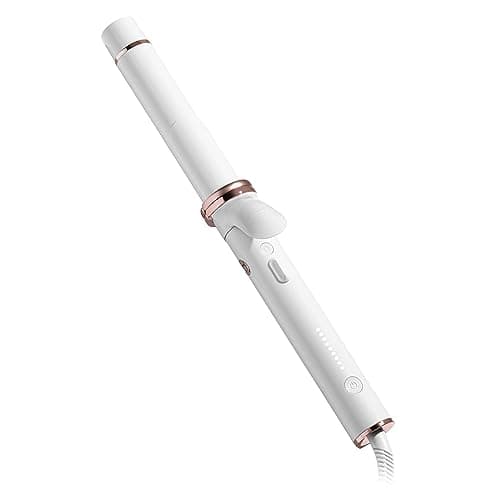
T3 CurlWrap automatic rotating curling iron
The barrel turns itself, which removes the wrist technique entirely — nine heat settings and genuine dual voltage alongside it.
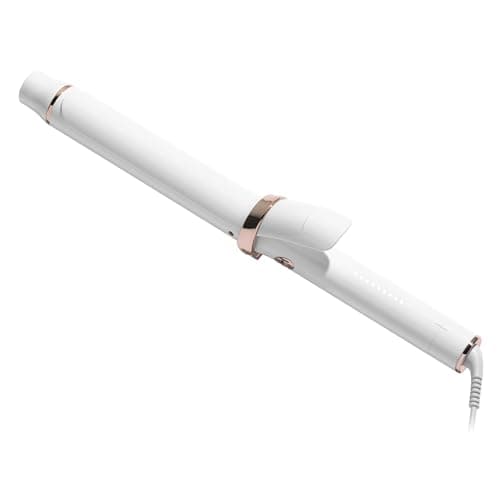
T3 SinglePass Curl X extra-long barrel curling iron
A 6.5-inch barrel and a separate published weight for every barrel size — unusual disclosure in a category where most makers publish a diameter and stop.
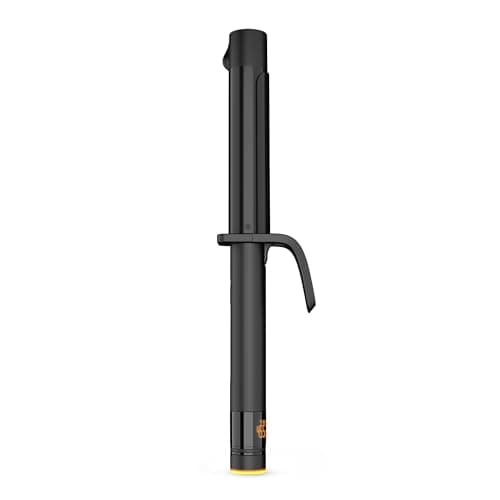
Hot Tools Black Gold 1¼" Digital Salon Curling Iron
A lifetime limited warranty and universal dual voltage on a curling iron that costs a fraction of the ghd Curve — against no published wattage and no published weight.
Questions people actually ask
Should I buy the T3 Curl X or the T3 CurlWrap?
The CurlWrap if wrapping the hair is the part you get wrong, because its barrel turns itself and its timer gives every section the same dwell. The Curl X if your technique is fine — it publishes a 6.5 inch barrel, offers a third barrel size, has a lighter 10.6 oz option, and costs less for the same nine settings, cord, voltage and warranty.
What is the difference between the T3 Curl X and the CurlWrap?
The motor, and very little else. T3 publishes 78 W against 77 W, nine heat settings on both, the same 8 ft swivel cord, the same 100 to 240 V auto world voltage, the same Korean CeraGloss ceramic barrel, the same 1-hour auto shut-off and the same two-year warranty. The CurlWrap adds a rotating barrel, two rotation speeds, a 5-or-8-second timer and a training mode.
How many watts is the T3 CurlWrap?
77 W, against 78 W for the SinglePass Curl X. These are the only two curling tools in this registry whose maker publishes a wattage at all — ghd and Hot Tools publish none for any of their curling tools. At 65 hours a year, 77 W costs about 92 cents a year to run.
What temperature does the T3 CurlWrap reach?
T3 does not publish one. Both tools publish nine heat settings and neither states what any setting reaches in Fahrenheit or Celsius anywhere on its page. Nine steps is the most adjustment of any curling tool here, but a step count is not a temperature, so find the lowest step that holds a curl and leave it there.
Does the T3 CurlWrap rotate in both directions?
T3 publishes an AutoTwist switch it describes as steering barrel rotation with dual navigation, and a training mode that turns the heat off while you test rotation speed and direction. It does not use the word 'both' anywhere on the page, so we are reporting the controls it publishes rather than asserting a capability it does not state.
Is the T3 CurlWrap worth the extra money over the Curl X?
Only if you want the motor. The price gap is small and almost every other published row is a tie, so you are buying a substitution of hardware for a skill. If your curls already come out even, the Curl X gives you a published 6.5 inch barrel, a 1.5 inch size option and a lighter body for less.
Which T3 curling iron is lighter?
The SinglePass Curl X in its 1 inch barrel, at 10.6 oz without the cord. T3 publishes a weight per diameter for it — 10.6 oz at 1 inch, 13.2 oz at 1.25 inch and 15.1 oz at 1.5 inch — where the CurlWrap publishes a single 13.4 oz for both of its sizes.
Sources
- T3 Micro — SinglePass Curl X product page (re-read 2026-10-19, HTTP 200)
- T3 Micro — CurlWrap automatic rotating curling iron product page (re-read 2026-10-19, HTTP 200)
- Evans and Park - thermal cycling and mechanical properties
- U.S. Energy Information Administration — Electric Power Monthly, Table 5.3 (average residential price)