Curling Irons & Wands
T3 CurlWrap Review: A Motor, 77 Watts and Nine Settings
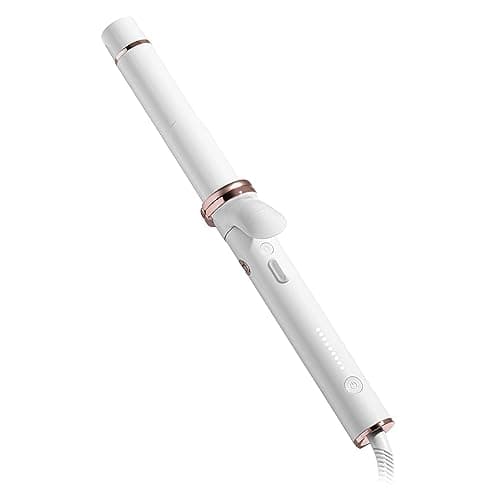
The barrel turns itself, which removes the one skill this category assumes you have. T3 is also now the only curling-tool maker here that will tell you what its tool draws.
Updated October 2026 · Sawyer V.
Buy it if the wrist motion is what stops you curling your own hair. T3 publishes 77 W, nine heat settings, two barrel rotation speeds, a 5 or 8 second timer, 13.4 oz without the cord, an 8 ft swivel cord, 100–240 V auto world voltage, a 1-hour auto-off and a two-year warranty. It is the only curling tool in this registry whose maker publishes a wattage. It publishes no temperature for any of the nine settings.
We earn a commission if you buy through the links on this page, at no extra cost to you. It never changes which tool we pick or which one we tell you to skip. How this site is funded.
The specification sheet, in full
T3 CurlWrap automatic rotating curling iron, as published
| Row | Published figure |
|---|---|
| Wattage | 77 W |
| Heat settings | 9 — step count only, no temperatures stated |
| Barrel rotation speeds | 2 |
| Timer | 5 or 8 seconds |
| Barrel | Korean CeraGloss ceramic, self-rotating, 1 in and 1¼ in |
| Weight | 13.4 oz (cord not included) |
| Cord length | 8 ft, 360-degree professional swivel |
| Dual voltage | Yes — 100–240 V auto world voltage |
| Auto shut-off | 1 hour |
| Heat-up time | Not published |
| Noise | Not published |
| Warranty | 2 years |
Quoted from T3's own product page, re-read 2026-10-08. The 77 W and 13.4 oz figures are newer than this site's first reading of that page on 2026-09-09, when neither was stated.
Ten rows filled of twelve. For a curling tool that is the most complete sheet on this site by a clear margin, and two of those rows — the wattage and the timer — are figures no other curling tool here publishes at all.
We should flag the change rather than quietly absorb it. When this site first read T3’s page, the wattage and weight rows were blank, and several of our pages said so. T3 has since added both. We have corrected the product record and every page that referred to those rows as missing; the correction is noted here because a site that publishes “Not published” as a factual claim owes you an account of it when the claim stops being true.
What the motor actually removes
A conventional curling iron asks you to do three things at once: hold the barrel at an angle, wrap a section around it evenly, and keep tension while it sets. The wrap is the part that takes practice, and it is the part that gets worse behind your own head where you are working by feel.
T3 calls the mechanism AutoTwist. The barrel rotates under its own power, so you feed the end of a section in and the tool pulls it around. That is a genuine removal of a skill rather than an easier version of it, and it is the entire argument for the tool. If you have put a curling iron down because the result was uneven rather than because it was slow, this is the specification that addresses you.
It is worth separating this from the other kind of automatic tool, because the two get sold under the same word and are not interchangeable. A rotating barrel is a contact tool that curls dry hair. A Coanda airflow tool — the Dyson Airwrap, the Shark FlexStyle — wraps hair with moving air and needs it damp, because it is drying the shape in. If what you want is to put a curl into second-day hair, the airflow tools cannot do it and this can. The automatic curlers compared sets both mechanisms out, and is the Dyson Airwrap worth it covers the damp-hair constraint in detail.
77 watts, and what that figure is worth
This is the newly published row and it is the most interesting thing on the sheet. Of the six curling tools in this registry, the CurlWrap is the only one whose maker states a wattage. Both ghd barrels, the ghd Wave, the Hot Tools Black Gold and T3’s own SinglePass Curl X all leave that row blank.
77 W is also remarkably low. It is the second-lowest published draw of any heated tool on this site, behind only the L’ange Le Duo at 36 W. The Dyson Corrale’s 200 W sits between them but is a battery rating rather than a mains draw, so it is not comparable.
Two honest cautions about reading too much into it. First, a low wattage on a curling tool is not an efficiency achievement in the way it would be on a dryer: a barrel holds a small mass of ceramic at temperature and draws in short bursts, so a small figure is what you would expect once somebody finally prints one. Second, it says nothing about how hot the barrel gets, which is the number that would actually matter and is the one T3 omits.
What it does buy you is arithmetic this site can finally do. At 65 hours a year and the U.S. average residential rate of 18.34 cents per kilowatt-hour, 77 W costs about 92 cents a year to run. That is not a reason to buy anything — the point of publishing it is that you can check it, and on five of the six tools here you cannot. The formula is at running costs.
13.4 ounces, and what the motor costs
The second new figure, and it answers the obvious objection to a motorized barrel better than T3’s marketing does.
T3 publishes 13.4 oz for the CurlWrap, cord excluded. It publishes 13.2 oz for the 1¼ in SinglePass Curl X on the same basis — the same barrel diameter, no motor. So the rotating mechanism costs two-tenths of an ounce.
That is a genuinely useful comparison and it is only possible because both figures come from the same maker on the same measurement basis. Weight matters on a curling tool for the same reason it matters on a flat iron: you hold it at head height with your wrist turned, once per section, and the last sections are where technique degrades. A motorized tool that weighs essentially the same as its manual sibling has given up nothing on the row you feel.
These two are also the only curling tools in this registry that publish a weight at all. ghd publishes none for the Chronos Curve Classic, the Curve Thin or the Wave, and Hot Tools publishes none for the Black Gold.
Nine settings, and the number T3 will not give you
Nine heat settings puts the CurlWrap in a category of two. It and the SinglePass Curl X are the only curling tools here with any temperature adjustment whatsoever: all three ghd barrels are fixed at 365°F, and the Hot Tools Black Gold publishes a 455°F ceiling with no floor and no step count.
Adjustment matters most on hair that has been processed, where the useful instruction is to spend as little heat as the style allows. Bleached and chemically treated hair starts with measurably less protein to spend Dyer et al., International Journal of Cosmetic Science, and repeated thermal cycling degrades the fiber’s mechanical properties whatever it started as Evans and Park, Journal of Cosmetic Science. Nine positions means the step you settle on is close to your actual requirement rather than the nearest coarse approximation.
And here is the limitation, which is the main criticism of this tool. T3 publishes a step count and no temperatures. Not a range, not a floor, not a figure for any of the nine positions. So you can select a low setting but you cannot check it against the guidance for your hair, and you cannot repeat it in any absolute sense — only as “position three.” For comparison, the L’ange Le Duo publishes a stated 280–430°F across five settings, and ghd tells you plainly that its barrels sit at 365°F. Both are more informative than nine unnamed steps.
The practical method is the same one we give everywhere: start at the lowest setting, raise one position at a time until a curl holds after a single wrap, and then stop there. What the numbers on a dial actually mean and what temperature is actually safe are the two pages to read before you pick a step.
The timer, which nothing else here has
T3 publishes a 5 or 8 second timer. No other curling tool in this registry publishes a timer of any kind, and it is a more thoughtful feature than it first sounds.
The reason is that “how long do I hold it” is the second unmeasurable in this category after temperature, and it is the one people get wrong in the expensive direction. Left to judgment, a curl that has not taken gets more seconds, and more seconds at an unknown temperature is exactly how cumulative damage accrues. A tool that ends the wrap for you converts a guess into a constant: if five seconds does not hold, you change the heat step rather than the duration, which is the better variable to move.
Two speeds do similar work in the other direction. A heavy section needs a slower wrap to feed in evenly; fine hair can take the faster one. Most rotating tools publish one speed or none.
Dual voltage, and the auto-off
T3 publishes 100–240 V auto world voltage. That is genuine dual voltage, so the CurlWrap runs on a 230 V supply with a plug adapter rather than a converter — and the distinction between those two objects is the one that destroys tools, which is why adapter vs converter exists.
In this registry four curling tools publish a usable voltage: this, the SinglePass Curl X, the ghd Curve Thin and the Hot Tools Black Gold. ghd publishes no voltage rating for the Chronos Curve Classic or the Wave, and an unstated voltage has to be treated as single. The travel curling irons has the picks, and the full dual-voltage list covers every tool on the site.
The published 1-hour auto-off is worth a line of its own, because the thing people actually worry about with a curling iron is whether they left it on. Three tools here publish an automatic shut-off figure; three do not.
The failure mode a manual barrel does not have
A rotating barrel can catch. If a section is fed in untidily — tangled ends, uneven thickness, too much hair at once — the mechanism will keep pulling, and it pulls from the root. That is a category of problem a manual iron simply cannot produce, because on a manual iron your hand stops when something snags.
It is a real consideration rather than a theoretical one, and it argues for two habits: detangle properly before you start, and feed smaller sections than feel efficient. Combing force rises steeply on hair that is already compromised Bloch et al., JEADV, so if a section is catching, the answer is a smaller section rather than more force. How to section properly has the sizes, and the detangling brushes covers the step before.
It also adds a moving part to a tool with a two-year warranty, which is the shortest cover of the three tools on this page — Hot Tools publishes lifetime limited cover on its Black Gold barrel. More mechanism and less warranty is a combination worth weighing; what a warranty is worth puts every figure side by side.
What is still missing
Two rows, and one of them matters a great deal.
- Temperature. The important omission. Nine settings with no stated degrees means the single figure that determines whether this tool is safe for your hair is absent, and T3 has now shown it is willing to add figures to this page — so this one is a choice.
- Heat-up time. Minor. Nobody in this category publishes it, and it changes how long you wait rather than what the tool does to your hair.
- Noise. Not published, and uniquely relevant here since this is the only curling tool on the site with a motor in it. No maker in this registry publishes a decibel figure for anything, so we cannot tell you whether the mechanism is audible — see how loud is a hair dryer for how consistently blank that row is.
Who should buy it, and who should not
- Buy it if the wrap is the barrier. If your curls come out uneven, or the back of your head defeats you, this removes the skill rather than asking you to improve it. That is the whole case and it is a good one.
- Buy it if you curl dry hair. It works on second-day hair, which the Airwrap and FlexStyle cannot do. If you were comparing it against those, this is the deciding difference.
- Buy it if you want a sheet you can check. Ten rows of twelve, including the only published wattage and the only published timer in the category.
- Buy it if you travel. 100–240 V published outright, with nothing to reconfigure.
- Do not buy it if you need a stated temperature. Fine, bleached, color-treated or already-damaged hair needs a number it can verify, and there is none here. The L’ange Le Duo publishes a 280°F floor; start at curling irons for damaged hair and curling irons for color-treated hair.
- Do not buy it if your hair tangles easily. The catching failure mode is real, and it is worse on hair that already snags.
- Do not buy it for the automation alone if you already curl competently. The manual SinglePass Curl X gives you the same nine settings, the same dual voltage, the same warranty and three barrel sizes for less, and it weighs two-tenths of an ounce less — see the T3 SinglePass Curl X review.
- Do not buy it on durability. Two years against Hot Tools’ lifetime limited cover, with an extra moving part.
For how the three mechanisms in this category actually compare, see the best automatic curlers and wand vs clamp. The brand picture is at the T3 brand page.
The tools on this page
Prices come from the live price layer. Where none is available the button says so rather than showing a number we cannot stand behind.
T3 CurlWrap automatic rotating curling iron
The barrel turns itself, which removes the wrist technique entirely — nine heat settings and genuine dual voltage alongside it.
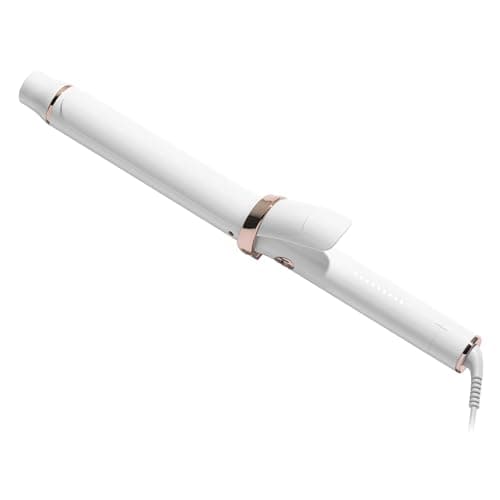
T3 SinglePass Curl X extra-long barrel curling iron
A 6.5-inch barrel and a separate published weight for every barrel size — unusual disclosure in a category where most makers publish a diameter and stop.
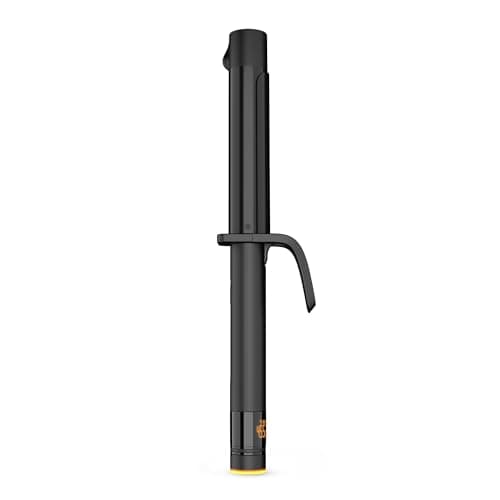
Hot Tools Black Gold 1¼" Digital Salon Curling Iron
A lifetime limited warranty and universal dual voltage on a curling iron that costs a fraction of the ghd Curve — against no published wattage and no published weight.
Questions people actually ask
How many watts is the T3 CurlWrap?
77 W, published by T3. It is the only curling tool in this registry whose maker publishes a wattage at all — both ghd barrels, the ghd Wave, the Hot Tools Black Gold and T3's own SinglePass Curl X leave that row blank. At 65 hours a year it works out to about 92 cents a year to run.
What temperature does the T3 CurlWrap reach?
T3 does not publish one. It states nine heat settings and no temperature for any of them — no range, no floor, no figure. That is the main criticism of the tool: you can select a low setting but you cannot check it against the guidance for your hair.
How heavy is the T3 CurlWrap?
13.4 oz without the cord. For comparison, T3 publishes 13.2 oz for the 1 1/4 inch SinglePass Curl X on the same basis — the same barrel diameter without a motor. So the rotating mechanism costs about two-tenths of an ounce.
Can the T3 CurlWrap curl dry hair?
Yes, and this is the main thing it does that an air styler cannot. A rotating barrel is a contact tool that works on dry hair, so it will put a curl into second-day hair. The Dyson Airwrap and Shark FlexStyle use airflow and need hair that is still damp.
Is the T3 CurlWrap dual voltage?
Yes. T3 publishes 100 to 240 V auto world voltage, so it runs on a 230 V supply with a plug adapter rather than a voltage converter. Four of the six curling tools here publish a usable voltage; ghd publishes none for the Chronos Curve Classic or the Wave.
Does the T3 CurlWrap pull or tangle hair?
It can, and this is a failure mode a manual barrel does not have: if a section is fed in untidily the mechanism keeps rotating and pulls from the root. Detangle before you start and feed smaller sections than feel efficient. If a section catches, use a smaller section rather than more force.
T3 CurlWrap or SinglePass Curl X?
The CurlWrap if the wrapping motion is what stops you curling your own hair. The Curl X if it is not — it publishes the same nine settings, the same dual voltage and the same two-year warranty, in three barrel sizes, for less money and two-tenths of an ounce lighter.
Does the T3 CurlWrap turn itself off?
Yes. T3 publishes a 1-hour automatic shut-off. Three of the six curling tools in this registry publish an auto-off figure and three publish nothing.
Sources
- T3 Micro — CurlWrap automatic rotating curling iron product page (re-read 2026-10-08)
- T3 Micro — SinglePass Curl X product page
- Dyer et al. - bleaching and the hair fiber
- Evans and Park - thermal cycling and mechanical properties
- Bloch et al. - combing force on Afro-ethnic hair
- U.S. Energy Information Administration — Electric Power Monthly, Table 5.3 (average residential price, June 2026)