Heat Damage & Protection
The Best Heat Protectant Sprays in 2026
There is real evidence behind conditioning before heat. There is almost no published specification behind any individual bottle, and that gap is the whole buying problem.
Updated September 2026 · Sawyer V.
Conditioning treatments before heat have measured support — fibers treated with conditioner showed improved characteristic life under repeated curling, especially low-molecular-weight ones that penetrate the fiber. What almost no brand publishes is a temperature rating, so buy on formulation type and application, not on a number.
We earn a commission if you buy through the links on this page, at no extra cost to you. It never changes which tool we pick or which one we tell you to skip. How this site is funded.
Quick picks
Tap any row to jump to the full write-up. Prices come from the live price layer; where none is available the button says so rather than showing a number we cannot stand behind.
| # | Product | Best for | Price |
|---|---|---|---|
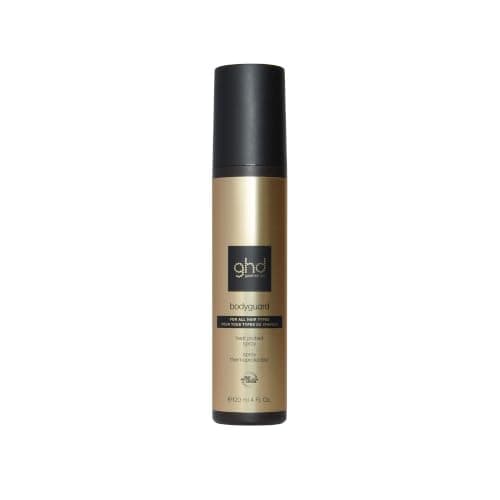
| 1 | ghd Bodyguard heat protect spray A leave-in thermal protection spray from the brand that fixes every tool it makes at 365°F — the same company arguing for restraint. | Anyone who wants a named product with a manufacturer behind it |
1. The one we can actually source
ghd Bodyguard heat protect spray
Best for: Anyone who wants a named product with a manufacturer behind it
A leave-in thermal protection spray from the brand that fixes every tool it makes at 365°F — the same company arguing for restraint.
This is the only heat protectant in our registry, and it is here for a specific reason: ghd publishes it as a product on their own site, which means there is a manufacturer page to cite and a company accountable for what it claims.
There is a coherence argument too. ghd fixes every iron and curling tool it makes at a single 365°F and builds its whole position around removing the temperature dial. A protectant from the brand whose tools run at one known temperature is at least designed against a known number.
What we cannot tell you is a temperature rating, a formulation breakdown or a bottle size we could read off the page. Those rows are not published, and we are not going to fill them in.
What’s wrong with it
ghd publishes no stated temperature rating, no weight and no warranty — on a consumable that is normal, and it still means the central claim is unquantified.
Published specifications — ghd Bodyguard heat protect spray
| Wattage | Not applicable — not a powered tool |
|---|---|
| Heat settings | Not applicable |
| Speed settings | Not applicable |
| Weight | Not published |
| Cord length | Not applicable |
| Noise (dB) | Not applicable |
| Attachments | Spray applicator |
| Plate / barrel | Leave-in thermal protection spray |
| Dual voltage | Not applicable |
| Warranty | Not applicable — consumable |
Every figure above is taken from ghd — Bodyguard heat protect spray product page. “Not published” means the figure does not appear on that page — it is not an estimate withheld, it is a number the manufacturer does not state. How we compile these.
What it costs to run for a year
ghd does not publish a wattage for this tool, so there is nothing honest to compute. The formula is watts ÷ 1,000 × hours a year × your rate per kWh; if you find a rating plate on the handle, 65 hours a year and 18.34 cents per kilowatt-hour will get you the rest of the way.
What the research actually supports
This is the rare subject in hair care where there is a real published result, and it is worth stating precisely because it is narrower than the marketing.
Researchers curling hair with a curling iron under a range of conditions found that fibers treated with conditioners showed an improvement in characteristic life — particularly low-molecular-weight conditioners able to penetrate into the fiber rather than sit on it — Ruetsch and Kamath, Journal of Cosmetic Science.
Separately, work analyzing repeated brushing and combing as a fatigue process found that conditioning treatments provided considerable retardation of breakage — Evans and Park, Journal of Cosmetic Science.
Two things to take from that. The mechanism is supported: something between the heat and the fiber, and something that penetrates rather than coats, measurably helps. And the supported claim is retardation — slowing damage down, not preventing it.
What no brand publishes
Here is the buying problem, and it is the same shape as every disclosure problem on this site.
- A temperature rating. “Protects up to 450°F” appears constantly in marketing copy and almost never as a specification with a test method attached. Protects how? Measured against what?
- A quantified effect. No bottle tells you how much less damage, on what hair, at what temperature, after how many applications.
- Molecular weight or penetration. The property the research actually singles out is the one nobody prints.
- How much to apply. The variable most likely to change the outcome, left to “spray evenly”.
So we rank one product — the one with a manufacturer page we can cite — and give you criteria for the rest, rather than assembling a ten-item list out of Amazon copy. That is the same position we take on storage bags and universal diffusers, and it does not relax because the search volume is large.
How to choose without a spec sheet
What to look for, and why
| Criterion | Why it matters |
|---|---|
| Leave-in rather than rinse-out | It has to be present at the moment heat is applied |
| A named brand with a product page | Someone accountable for the claim, and a source to cite |
| Light enough not to weigh hair down | Product weight is one of the forces that drops a style |
| A fine mist rather than a stream | Even coverage is the whole point; a wet patch protects one section and weighs down another |
| Alcohol low in the ingredient list | High-alcohol formulas evaporate fast, which is convenient and drying |
| Compatible with your tool's temperature | If your iron is fixed at 365°F you know the number; if it has nine settings you do not |
Application is where most of the benefit is lost
The research finding concerns conditioner being present in and on the fiber. That makes application at least as important as which bottle you bought, and it is where most people lose the benefit.
Apply to damp hair, then dry before heat contact
Most protectants are designed for damp application. But applying a protectant and then immediately clamping an iron onto still-wet hair is the worst of both worlds — water inside the fiber turns to steam when it meets a hot surface, and published microscopy shows that causes bubbling and buckling of the cuticle on top of the usual cracking.
Spray damp, dry properly, then style. The mechanism is on the wet hair page.
Section it, do not mist the outside
Spraying the outside of a head coats the outside of a head. The hair that gets ironed is inside those sections too. Apply as you section — the routine is on the sectioning guide.
Mid-lengths and ends, not roots
The roots are the newest, strongest hair you own and they do not need it. The ends are two years old, have measurably less lipid and lower tensile strength, and are where the iron does the most harm — the mechanism is here.
Less than you think
Heavy application weighs hair down, and weight is one of the forces that pulls a style out. A protectant that ruins the result is a protectant you will stop using.
What a protectant is not
It is not permission. This is the most important paragraph on the page.
The supported claim is that conditioning slows damage down. It does not make 450°F safe, it does not undo anything, and it does not change the arithmetic that total exposure is roughly temperature multiplied by contact time. A protectant plus three passes is worse than no protectant plus one.
Nothing restores hair structurally once it is damaged — the honest version of that is on the repair page, and it is not the answer most sites give. The interventions that outrank buying a protectant are all free: dry properly first, use fewer passes, drop a step on the ends, and finish cool.
Our fuller treatment of what a protectant does and does not do, without the product angle, is on the heat protectant guide.
Price per use, at 5 uses a week over 5 years
| What you pay | Cost per use | Cost per year |
|---|---|---|
| $30 | $0.02 | $6.00 |
| $60 | $0.05 | $12.00 |
| $100 | $0.08 | $20.00 |
| $150 | $0.12 | $30.00 |
| $200 | $0.15 | $40.00 |
| $300 | $0.23 | $60.00 |
| $400 | $0.31 | $80.00 |
| $500 | $0.38 | $100.00 |
5 uses a week for 5 years is 1300 uses. Both figures are stated assumptions, not measurements — halve the life and every cost per use doubles. We publish the ladder rather than a worked example for one specific product because a price we typed into a sentence would be wrong within a week.
Who needs one most
- Bleached or double-processed hair. It arrives at the iron already carrying molecular changes normally associated with thermal treatment — the case is here.
- Anyone using a fixed-temperature tool on processed hair. Every ghd tool runs at 365°F with no way down, so the only variable left to change is what sits between the plate and the fiber.
- Daily heat users. The measured benefit is cumulative retardation, which means it compounds with frequency.
- Not: people who use heat twice a month. Honestly, the technique changes matter more and cost nothing.
The tools on this page
Prices come from the live price layer. Where none is available the button says so rather than showing a number we cannot stand behind.
ghd Bodyguard heat protect spray
The heat protectant from a brand that fixes every tool it makes at 365°F — the same company arguing for restraint, selling the thing that buys you some.
Questions people actually ask
Do heat protectants actually work?
There is measured support for the mechanism: fibers treated with conditioners showed improved characteristic life under repeated curling, and conditioning considerably retarded breakage in repeated-grooming experiments. The supported claim is slowing damage, not preventing it.
What temperature does heat protectant protect up to?
Nobody publishes a rating with a test method attached. The figures in marketing copy are not specifications you can check, which is why we recommend choosing on formulation and application rather than on a number.
Should I apply heat protectant to wet or dry hair?
Most are designed for damp application — but dry the hair before any contact heat touches it. Water inside the fiber turns to steam against a hot surface, which causes bubbling and buckling of the cuticle.
Does heat protectant mean I can use a higher temperature?
No. It slows damage down; it does not make a higher setting safe, and it does not change the fact that total exposure is temperature multiplied by contact time. A protectant plus three passes is worse than no protectant plus one.