Brushes & Accessories
Microfiber Hair Towels: The Cheapest Way to Cut Drying Time
The single biggest reduction in heat exposure available to anyone costs nothing and happens before you switch anything on.
Updated September 2026 · Sawyer V.
Squeezing surface water out before any heat is the largest free reduction in drying time available, and it routinely takes five to eight minutes off a long dry. What matters in a towel is absorbency and a smooth surface — friction is the thing you are trying to avoid.

We earn a commission if you buy through the links on this page, at no extra cost to you. It never changes which tool we pick or which one we tell you to skip. How this site is funded.
Why this page exists on a hair tool site
Because the arithmetic is better than anything we sell. Drying hair is evaporation: it depends on how much warm air passes over the wet surface and how much water is there to begin with.
A dryer is very good at the first term and extremely inefficient at the second. Water sitting on the outside of your hair can be removed mechanically in seconds, or blown off with a heating element for several minutes. Choosing the second is choosing to apply heat to solve a problem that a towel already solved.
On dense or long hair this step alone routinely takes five to eight minutes off the session — and total heat exposure is roughly temperature multiplied by contact time. The full arithmetic is on the drying time page.
Squeeze, do not rub — and why it matters
The instruction everyone gives, with the mechanism attached.
Hair is at its most extensible when wet, which makes it easier to stretch past recovery. And repeated mechanical loading behaves as a fatigue process: individual fibers experience repeated exposure, flaws propagate, and eventually failure results — Evans and Park, Journal of Cosmetic Science.
Vigorous rubbing with a towel is a lot of small loading events applied to hair in its most vulnerable state, and it does it while tangling the hair into exactly the looped and crossed formations that produce impact loads when you later comb it out — Robbins, Journal of Cosmetic Science.
So the rubbing is not just inefficient. It creates the tangles that cause the breakage you get half an hour later — the detangling page covers that half.
What to look for
We do not rank towels. Every product on this site carries a spec block read off the manufacturer’s own page, and this category is sold overwhelmingly by brands that publish no material composition, no GSM and no absorbency figure you could compare. Ranking them would mean inventing the data — the same position we take on storage bags and universal diffusers.
The criteria, which are short because there is not much to compare:
What actually differs between hair towels
| Property | What to look for | Why |
|---|---|---|
| Surface texture | Smooth rather than looped or terry | Loops catch on the cuticle and create tangles |
| Absorbency | Enough that it goes damp rather than soaking through | A saturated towel stops removing water |
| Size against your hair | Large enough to wrap without tension | A small towel gets wound tight, which is traction at the root |
| Fastening | A loop or button rather than a twist | Twisting to secure it is the tension you are avoiding |
| Weight when wet | Light | A heavy wrap pulls at the hairline for as long as it is on |
The mistake the wrap encourages
Worth naming because the product actively invites it: wrapping tightly and leaving it on for a long time.
A tight wrap applies sustained tension at the hairline — the same loading pattern we flag on the rollers page. Traction at the root is a known mechanism of hair loss in other contexts, and “it is only a towel” does not follow.
Wrap loosely enough that it stays up and no tighter, and take it off once it has done its job rather than wearing it while you get ready. Ten minutes is doing nearly all of the work.
The routine that actually saves time
- Squeeze section by section rather than piling everything up and rubbing. Press, release, move down.
- Wrap loosely and wait ten minutes. This is the step that does the work, and it is free.
- Then rough-dry on a bare nozzle, no attachment, until the hair moves freely — around 70 to 80 percent.
- Only then fit the attachment and style. Fitting a concentrator at the start makes the whole-head dry slower — why.
- Detangle after conditioning, not after towelling. Ends first, working up.
Where this fits against everything else
If you rank interventions by effect per dollar, this one is at the top with the detangling technique, and both beat every heated tool we sell.
Free changes, against what a purchase buys
| Change | Effect | Cost |
|---|---|---|
| Towel properly and wait ten minutes | 5–8 minutes off a long dry, every time | Free |
| Rough-dry with no attachment first | Several minutes; attachments narrow the airflow | Free |
| Section before drying | Removes the go-back-over-it pass | Free |
| A dryer with more heat steps | A lower setting available on the lengths | A purchase |
| A more powerful dryer | Unclear — wattage is heat, not airflow | A purchase |
The last row is the honest one. Nobody in this category publishes airflow in comparable units, so buying more power is not a reliable route to a faster dry — the wattage page.
Price per use, at 5 uses a week over 5 years
| What you pay | Cost per use | Cost per year |
|---|---|---|
| $30 | $0.02 | $6.00 |
| $60 | $0.05 | $12.00 |
| $100 | $0.08 | $20.00 |
| $150 | $0.12 | $30.00 |
| $200 | $0.15 | $40.00 |
| $300 | $0.23 | $60.00 |
| $400 | $0.31 | $80.00 |
| $500 | $0.38 | $100.00 |
5 uses a week for 5 years is 1300 uses. Both figures are stated assumptions, not measurements — halve the life and every cost per use doubles. We publish the ladder rather than a worked example for one specific product because a price we typed into a sentence would be wrong within a week.
One thing to be careful about
Do not let a good towel routine become an excuse to apply contact heat to hair that is still damp. Towel-dried is not dry.
Published microscopy of hair thermally treated while wet shows severe damage plus bubbling and buckling of the cuticle, caused by steam forming inside the fiber and escaping — Ruetsch and Kamath, Journal of Cosmetic Science. A dryer moves air past hair and is fine on damp; an iron presses a hot surface against it and is not — the full page.
The tools on this page
Prices come from the live price layer. Where none is available the button says so rather than showing a number we cannot stand behind.
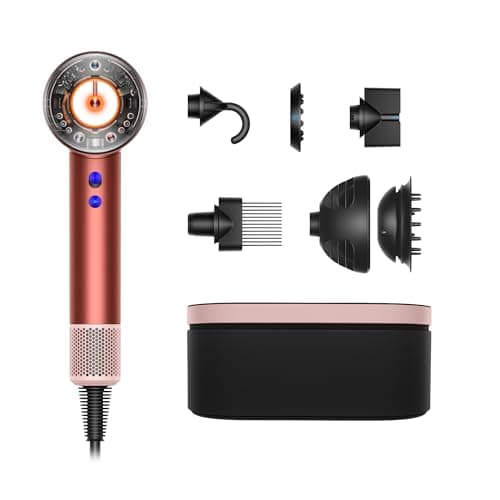
Dyson Supersonic hair dryer
1,600 W is less power than a drugstore dryer draws, and Dyson publishes that openly — the pitch is airflow and heat control, not wattage.
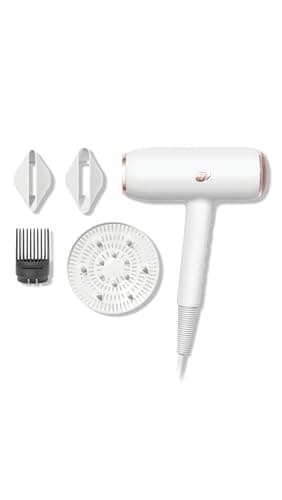
T3 Featherweight StyleMax professional hair dryer
Fifteen heat-and-speed combinations and the lightest published weight of the corded dryers here — but T3 does not publish a wattage figure at all.
Questions people actually ask
Do microfiber hair towels actually work?
The mechanism is straightforward: removing surface water mechanically is far more efficient than evaporating it with a heating element. On dense or long hair the towel step routinely takes five to eight minutes off the dry.
Why should you squeeze rather than rub hair with a towel?
Hair is at its most extensible when wet, and rubbing is many small loading events in that state. It also creates the looped and crossed tangles that produce impact loads when you comb it out later.
How long should I leave a hair towel on?
About ten minutes does nearly all the work. Leaving a tight wrap on while you get ready applies sustained tension at the hairline for no additional drying benefit.
Why don't you recommend a specific hair towel?
Because the category is sold by brands that publish no material composition, GSM or absorbency figure we could compare, and every product on this site carries a spec block sourced from the maker's own page.
Sources
- Evans and Park — A statistical analysis of hair breakage II: repeated grooming experiments, J Cosmet Sci 2010
- Robbins — Hair breakage during combing II: impact loading and hair breakage, J Cosmet Sci 2006
- Ruetsch and Kamath — Effects of thermal treatments with a curling iron on hair fiber, J Cosmet Sci 2004