Multi-Stylers & Dupes
Air Styler vs Flat Iron: Can an Air Styler Straighten Hair?
People buy an air styler hoping it replaces the iron. On published figures it does not, and the reason is a gap of 85 degrees before you even get to the plates.
Updated November 2026 · Sawyer V.
No, not in the way a flat iron does — and the published temperatures show why. The hottest figure any air styler in this registry publishes is Calista’s 195°F ceiling. The coolest figure any flat iron here publishes is the L’ange Le Duo’s 280°F floor, and ghd fixes its irons at 365°F. An air styler smooths hair with moving air; a flat iron presses it between two hot plates. Those produce different finishes, and on coarse or coily hair only one of them produces straight.
We earn a commission if you buy through the links on this page, at no extra cost to you. It never changes which tool we pick or which one we tell you to skip. How this site is funded.
The 85-degree gap nobody mentions
Put the two classes’ published temperatures on one line and the question mostly answers itself.
Published temperature figures, air stylers against flat irons
| Tool | Class | What the maker publishes |
|---|---|---|
| Calista EliteAir Gen 2 | Air styler | 85/120/175°F on low speed, 85/130/195°F on high - a 195°F ceiling |
| Dyson Airwrap, Shark FlexStyle, Shark IonCurl, T3 Aire 360 | Air styler | No degree figure at all - settings counts only, or nothing |
| L'ange Le Duo | Flat iron | 5 settings, 280-430°F - the lowest published floor of any iron here |
| ghd Platinum+ and ghd Chronos | Flat iron | One fixed temperature, 365°F |
| Dyson Corrale | Flat iron | 3 heat settings; Dyson's stated starting point is 365°F |
| CHI Original 1 in | Flat iron | A single preset, 392°F (202°C) |
| CHI Lava 1 in | Flat iron | A single preset, 395°F (202°C) |
| T3 SinglePass StyleMax | Flat iron | 9 heat settings; no degrees published for any position |
| Hot Tools Black Gold Evolve | Flat iron | Variable, up to 455°F |
Quoted from each maker's own product pages. dyson.com has returned HTTP 403 to every automated fetch since 2026-10-17 and t3micro.com rate-limited today, so those rows are the readings already on file with their source URLs.
The hottest published air-styler setting on this site is 195°F. The coolest published flat-iron floor is 280°F. Those ranges do not overlap. Against ghd’s fixed 365°F the gap is 170 degrees; against the Hot Tools ceiling it is 260.
One honest caveat before anyone over-reads that: four of the five air stylers publish no temperature at all, so strictly the comparison is between one published air figure and eight published iron figures. The four blanks could be hotter than 195°F and we cannot rule it out — but none of them is going to be 365°F, because a tool that blows air at 365°F across your scalp is not a product anyone ships.
Smoothing and pressing are different operations
Temperature is the measurable half. The mechanism is the half that explains it.
Hair holds its shape through hydrogen bonds in the keratin. Heat plus moisture lets those bonds release, and they reform as the hair cools — in whatever shape the hair was held while that happened. Both classes exploit the same physics. What differs is how the hair is held.
A flat iron holds it dead flat under pressure. Two heated plates close on the section and you draw them along it. Heat and mechanical pressure arrive at the same moment on both faces of the hair, and the shape the bonds reform into is the shape of the gap between two parallel plates: flat.
An air styler holds it in a curve under tension. There is no clamped heated plate anywhere in the class — the barrels shape with moving air, which on the Dyson and the Shark is the Coanda effect pulling hair onto the barrel and holding it there. With a paddle or smoothing brush attachment you get tension along the length and warm air over the surface, which lays the cuticle down and removes frizz. That is smoothing. It is not pressing.
So the finishes are genuinely different objects, not better and worse versions of one thing. An air styler produces a blow-out straight: smooth, polished, with movement and body. A flat iron produces a pressed straight: flat, sleek, no body. If what you want is the first, the styler is the right tool and the iron will overshoot it. If what you want is the second, no amount of airflow gets you there.
Which it can do depends on your hair, not the price
This is where the honest answer stops being one answer.
- Fine to medium, straight to wavy hair. An air styler can absolutely give you smooth, straight-looking hair here, and at under 200°F rather than over 365°F. For this hair the styler genuinely does replace the iron for everyday purposes — air stylers for fine hair.
- Thick or dense hair. Partly. Airflow has to dry and shape a lot of fiber, and the Airwrap’s 1,300 W is the lowest published mains draw in this registry, so sessions run long. Expect smooth rather than sleek — air stylers for thick hair.
- Curly hair. An air styler will stretch and smooth a curl and give you a loose, soft result. It will not give you the flat finish an iron gives. Many people find that is what they actually wanted — air stylers for curly hair.
- Coily and 4C hair. No. A pressed straight on tightly coiled hair is a plates job, and the published temperatures are the reason — flat irons for 4C and coily hair and the silk press. The honest companion to that is what heat damage on 4C hair looks like, because this is the hair with the least margin.
- Already heat-damaged or bleached hair. The styler, if either. 170 fewer degrees and no clamped contact is the whole argument — heat styling on bleached hair.
They are not even used at the same moment
A point that gets lost in the price comparison: these two tools enter the routine at different stages, so for many people they are not alternatives at all.
An air styler works on damp hair — it dries as it shapes, which is the entire reason the class exists. A flat iron must be used on bone-dry hair, because water inside the fiber turns to steam against a 365°F plate and that is a worse kind of damage than dry heat: what heat actually does to wet hair.
So the realistic pairing for a lot of people is not one or the other. It is the styler for the dry-and-smooth stage most mornings, and the iron kept for the days that need pressed-flat. If you own both, you use the iron less, which is the actual benefit — how often you can safely heat-style is the page that matters there, and how many hair tools you actually need is the honest arithmetic on owning two.
What each class gives you
Air styler class against flat iron class, on published rows
| Row | Air styler | Flat iron |
|---|---|---|
| Clamped heated plate | None in the class | Yes - that is the tool |
| Hair state to start | Damp - it dries as it shapes | Bone dry only |
| Finish it produces | Smooth with movement and body | Pressed flat and sleek |
| Published temperature | One of five publishes any: 85-195°F | All eight publish a figure, a preset or a ceiling |
| Lowest published figure in class | 85°F (Calista, cool) | 280°F (L'ange Le Duo floor) |
| Highest published figure in class | 195°F (Calista) | 455°F (Hot Tools ceiling) |
| Also makes curls | Yes - barrels are the point | With technique, but it is not what it is for |
| Also dries hair | Yes; the Shark FlexStyle converts to a dryer at 1,600 W | No |
| Longest warranty in class | 2 years | Lifetime limited (Hot Tools); 3 years on both ghd irons |
| Cheapest route into the class | A dupe-class styler | Far cheaper than the styler class |
| Travels | One publishes dual voltage (T3 Aire 360) | Several - ghd Platinum+, T3 StyleMax, CHI, L'ange Le Duo |
Our reading of each maker's published figures, not a manufacturer claim. The class totals cover the five air stylers and eight flat irons in this registry.
Two rows there are worth more than the rest. The iron class wins warranty outright — a lifetime limited warranty and two three-year warranties against a class where nothing exceeds two years. And it wins travel, because several irons publish dual voltage where exactly one styler does: the full dual-voltage list.
If the answer is an iron, which one
Ranked on the row that matters for the job rather than on price.
- ghd Platinum+, if you want the decision removed. One fixed 365°F, no dial to overshoot, universal voltage and a three-year warranty — the longest fixed-term cover on any iron here. The restrained choice — the Platinum+ review.
- T3 SinglePass StyleMax, if you want range. Nine heat settings is the most adjustment of any iron here, at 11.1 oz the lightest, with genuine 100–240 V dual voltage — the StyleMax review.
- L’ange Le Duo, if your hair is fragile. A published 280°F floor is the lowest starting temperature of any iron in this registry, and it has a fan, so it smooths from damp in a way no other iron here does — the Le Duo review and flat irons for damaged hair.
- Not a 455°F ceiling, for this job. The top of that range is not a feature. Coarse resistant hair may want the upper half of a range; nothing wants the top of that one.
If the answer is a styler, which one
- Calista EliteAir Gen 2, if you want to know the temperature. The only air styler here that publishes one, 85–195°F in a real grid, with a dryer base and an oval smoothing brush in the box — the EliteAir review.
- Shark FlexStyle, if it has to replace your dryer too. 1,600 W published, the most in the class, and it converts rather than offering a nozzle — the FlexStyle review and the Airwrap dupe field.
- Dyson Airwrap, if shape range is the point. Four published attachment families including smoothing brushes — is the Airwrap worth it, by hair type.
And if what you actually want is just the smooth blow-out rather than the curls, a hot air brush does that job for a fraction of either class — air styler vs hot air brush is that comparison, and the best straightening brushes is the shape built specifically for it.
The short version
- Air styler, if you want smooth with body on fine to wavy hair, from damp, at under 200°F.
- Flat iron, if you want pressed flat — and especially on coarse, curly or coily hair, where airflow will not get there.
- Flat iron, if the warranty or travel decides it. Lifetime and three-year cover exist in the iron class; nothing in the styler class exceeds two years, and only one styler travels.
- Air styler, if your hair is fragile or already damaged and you can live with smooth rather than sleek. 170 fewer degrees and no clamped contact is a real difference.
- Both, if you can only afford it once: buy the one that covers most of your days, and borrow the other occasion from a cheaper tool rather than from a second flagship.
- Neither, if the honest answer is a brush. A hot air brush is the cheapest route to a smooth blow-out and most people asking this question want exactly that.
What we could not compare
How long each finish lasts, and how it holds up in humidity. This is the comparison readers most want and no maker publishes anything on it. The mechanism suggests a pressed set and an airflow set behave differently, but we are not going to turn a mechanism into a claim about hours — styling for humidity is as far as the evidence goes.
Total heat exposure, which is the damage question. One pass of a plate at 365°F against several minutes of air at under 200°F is not a sum anyone can do: no maker publishes dwell time, contact time or how much heat actually transfers to the fiber. What is established is that repeated thermal cycling measurably degrades hair’s mechanical properties Evans and Park, Journal of Cosmetic Science and that bleached or chemically processed hair starts with less margin Dyer et al., International Journal of Cosmetic Science. Which tool spends less of that margin is a question the published data cannot settle, and anyone telling you otherwise is guessing.
Also: any temperature at all on four of the five air stylers. Heat and speed counts on the Shark FlexStyle. Degrees for any of the T3 SinglePass StyleMax’s nine settings. Plate surface temperature as opposed to the setting, on every iron. Airflow volume, on all five stylers. Noise, on everything in this registry — no maker publishes a decibel figure. And we hold no first-party testing of any of it; how we research sets out exactly what that means.
The tools on this page
Prices come from the live price layer. Where none is available the button says so rather than showing a number we cannot stand behind.
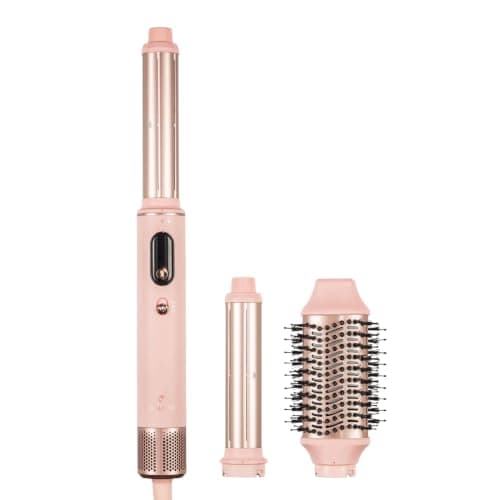
Calista EliteAir Multi-Style Dryer Gen 2
An air styler that publishes a temperature for all six settings and tops out at 195°F — lower than any other multi-styler here, and the whole argument for buying it.
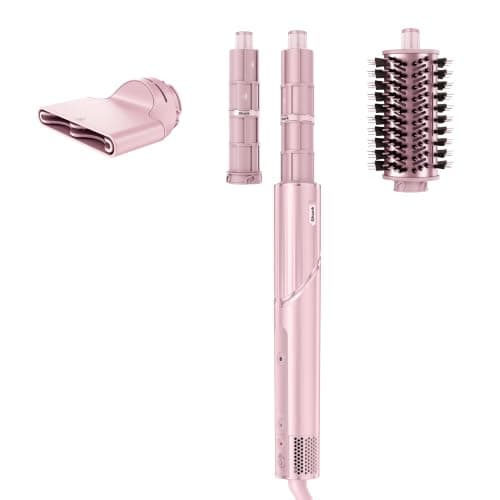
Shark FlexStyle air styling and drying system
Exactly the same published wattage as the Dyson Supersonic, in a tool that also converts to a dryer — the single strongest number in the dupe argument.
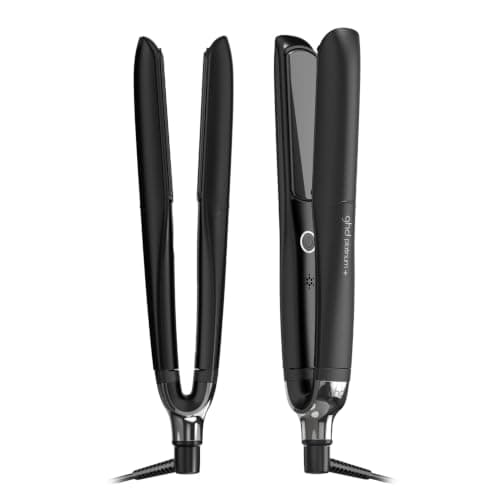
ghd Platinum+ flat iron (1 inch plate)
One temperature, 365°F, no dial to get wrong — the strongest heat-discipline argument in the category, and the longest iron warranty here at three years.
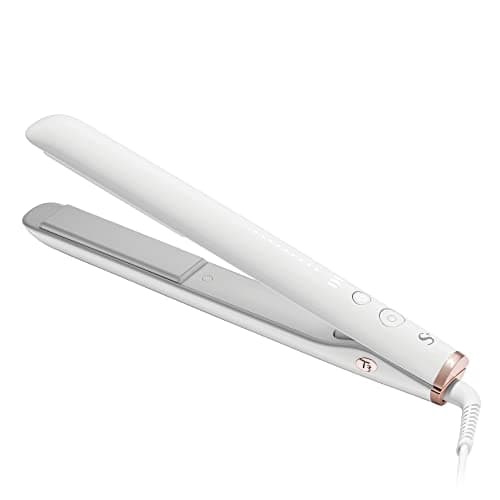
T3 SinglePass StyleMax 1 inch flat iron
Nine heat settings and genuine 100–240 V dual voltage: the most adjustable iron here and the only one you can pack for Europe without a thought.
Questions people actually ask
Can an air styler straighten your hair?
It can make hair smooth and straight-looking, but it cannot press it flat the way a flat iron does. The hottest temperature any air styler in this registry publishes is 195 degrees Fahrenheit; the coolest any flat iron publishes is a 280 degree floor, and ghd fixes its irons at 365. Those ranges do not overlap.
Will a Dyson Airwrap replace my flat iron?
On fine to wavy hair, for everyday smoothing, often yes. On coarse, curly or coily hair, no — a pressed straight needs plates and the published temperatures are the reason. Dyson also publishes no temperature figure for the Airwrap at all, so you cannot check it against guidance for your hair.
Which is more damaging, an air styler or a flat iron?
The published data cannot settle it, and we will not pretend otherwise. An air styler runs far cooler and never clamps; a flat iron is hotter but does the job in one pass. No maker publishes dwell time or heat transfer, so one pass at 365 degrees against several minutes of air under 200 is not a sum anyone can do.
What is the difference between smoothing and straightening?
Smoothing lays the cuticle flat with warm air and tension, which removes frizz and adds polish while leaving movement and body. Straightening presses the hair between two hot plates so its bonds reform in the shape of that gap — flat and sleek, with no body. They are different finishes, not better and worse versions of one.
Do I need both an air styler and a flat iron?
Many people end up with both, and the sensible version is a styler for the smooth-and-dry stage most days with an iron kept for days that need pressed-flat. The benefit is using the iron less often. If budget allows only one, buy for the finish you need most days.
Can you use an air styler on wet hair?
Yes — that is what it is designed for, and it dries as it shapes. A flat iron is the opposite: it must be used on bone-dry hair, because water inside the fiber turns to steam against a 365 degree plate, which is a worse kind of damage than dry heat.
Which class has the better warranty?
The flat irons, clearly. The Hot Tools Black Gold Evolve publishes a lifetime limited warranty and both ghd irons publish three years, where nothing in the air styler class exceeds two years. Since nobody in this category publishes an expected lifespan, warranty length is the only durability promise in writing.
Sources
- Calista — EliteAir Multi-Style Dryer Gen 2 product page (last read 2026-10-22; every figure held)
- SharkNinja — Shark FlexStyle product page
- ghd — Platinum+ flat iron product page (ghdhair.com has returned HTTP 403 to automated fetches; figures are the reading on file)
- T3 Micro — SinglePass StyleMax product page (t3micro.com returned HTTP 429 on 2026-11-02 and 2026-10-26; figures are the reading on file)
- L'ange — Le Duo 360° Airflow Styler product page
- Evans and Park - thermal cycling and mechanical properties
- Dyer et al. - bleaching and the hair fiber